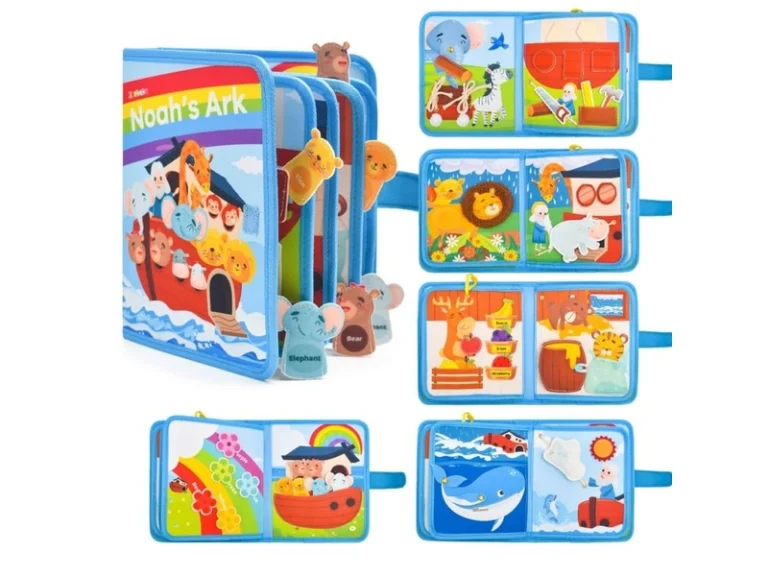
A Busy Board is a hands-on educational toy designed to encourage children to interact with physical activities rather than simply watch or listen. When thoughtfully designed, it can combine play with opportunities to practice fine motor skills, hand-eye coordination, sensory exploration, and basic recognition.
For B2B buyers, choosing a high-quality busy board requires a broader evaluation. The materials should withstand frequent interaction, the activities should have a clear purpose, and the product should meet relevant safety and compliance requirements. For brands and distributors, customization, packaging, MOQ, and production requirements also need to be considered.
This guide looks at what makes a high-quality Felt Busy Board, from materials and design to safety, before introducing a custom farm-themed option for commercial sourcing.
What Is a Montessori Busy Board?
A Montessori busy board is an interactive early educational product built around hands-on activities. Instead of relying mainly on electronic functions, it encourages children to explore physical elements through actions such as touching, matching, pulling, and rotating.
The purpose is not simply to keep children occupied. A well-planned busy board can provide opportunities for children to practice specific skills while engaging with a recognizable theme or learning concept.
How Does a Busy Board Support Early Learning?
Different activities can support different aspects of early learning.
For example, hands-on activities can be used for fine motor skills training, while activities that require children to observe and manipulate an element can support hand-eye coordination. Tactile interaction can also contribute to sensory exploration.
For B2B buyers, it is important to evaluate whether the activities have a clear educational or developmental purpose instead of focusing only on the number of interactive elements.
What Makes a Busy Board Different from a Traditional Toy?
A busy board places hands-on interaction at the center of the play experience.
Rather than providing one fixed function, it can combine multiple activities within a single product. This makes the design itself an important part of the product’s value.
For educational toy brands, preschools, and distributors, a well-organized activity structure can also make the product easier to position for different applications, such as early education, home learning, or travel activities.
What Materials Make a High-Quality Felt Busy Board?
The material structure of a busy board can affect its appearance, tactile feel, and everyday user experience.
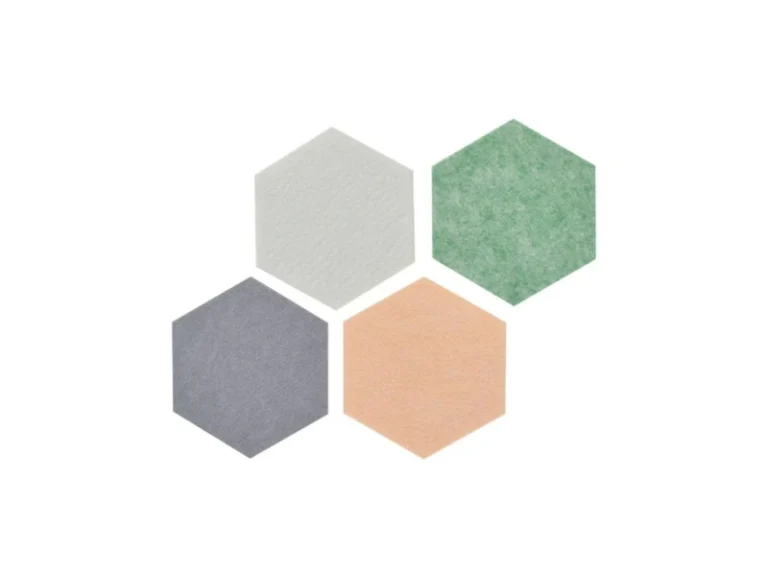
For example, twill fabric can be used as the outer surface to provide vibrant color reproduction for printed designs while also making the product easier to wipe clean. Felt provides a soft textile texture that is suitable for hands-on interaction, while eco-polyester can be used as part of the overall material structure.
For B2B buyers, it is important to confirm the actual materials used and how they are combined before mass production. This helps ensure that the bulk production matches the approved sample in terms of materials, appearance, and overall construction.
What Design Features Should a High-Quality Busy Board Have?
Materials alone do not determine the quality of a busy board. The activities and their arrangement are equally important.
Interactive Activities for Fine Motor Skills
A busy board can provide children with opportunities to practice controlled hand and finger movements.
Activities that involve pulling, matching, or other hands-on actions can make the learning experience more interactive. For B2B buyers, the key consideration is whether these activities are appropriate for the intended users and integrated logically into the overall design.
Activities That Encourage Hand-Eye Coordination
Some busy board activities require children to visually identify an element and then manipulate it with their hands.
This type of interaction combines visual attention with physical movement and can support hand-eye coordination.
A good design should make these interactions clear and manageable rather than unnecessarily complicated.
Age-Appropriate Activity Design
Age suitability is another important consideration. A product intended for younger children should have activities that match their developmental stage and intended use.
Buyers should also distinguish between the age for which a product is designed and the age specified for compliance in the target market.
What Safety and Compliance Factors Should Buyers Consider?
Safety and compliance are important when sourcing children’s educational products. For B2B buyers, it is not enough to look at the product’s appearance or functions. Age requirements, safety standards, materials, and labeling should also be checked before placing a bulk order.
Check the Recommended Age
The recommended age is one of the first things buyers should check.
A product may be designed for younger children, while the safety requirements for a specific market may set a different minimum age. Therefore, buyers should make sure the age information shown on the product, packaging, and product listing is clear and consistent.
It is also important to confirm the applicable age requirements with the manufacturer before production, especially when selling the product in different markets.
Understand the Relevant Safety Standards
Different markets may have different requirements for children’s products. Buyers should therefore confirm which safety standards apply to their target market.
For example:
- ASTM F963 is a toy safety standard used in the United States.
- CPSIA sets safety requirements for children’s products sold in the United States.
- EN71 is a series of European standards covering toy safety.
These standards can help buyers evaluate whether a children’s educational product is suitable for a particular market. However, meeting one standard does not necessarily mean that a product meets every requirement in another market.
What Should Buyers Confirm Before Bulk Ordering?
Before placing an order, B2B buyers should ask the manufacturer to confirm:
- Which safety standards apply to the product
- The recommended and required age range
- The materials used
- Available compliance documents
- Product labeling requirements
- Packaging requirements for the target market
Checking these details early can help prevent problems later, especially when the product needs to be customized for a specific market. It also helps ensure that the product, packaging, and sales information are consistent before mass production.
Introducing ZOE Custom Felt Farm Busy Board
After evaluating materials, design, educational value, and compliance, buyers can use these criteria to assess individual products.
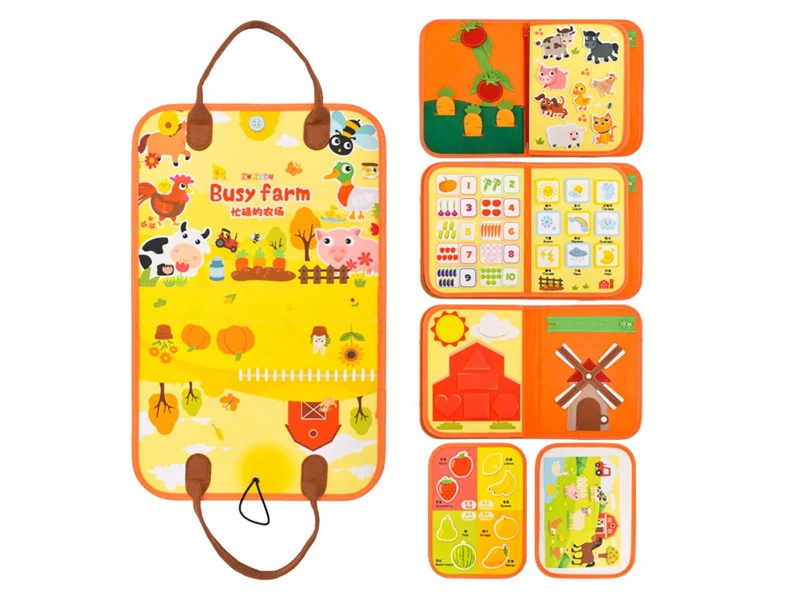
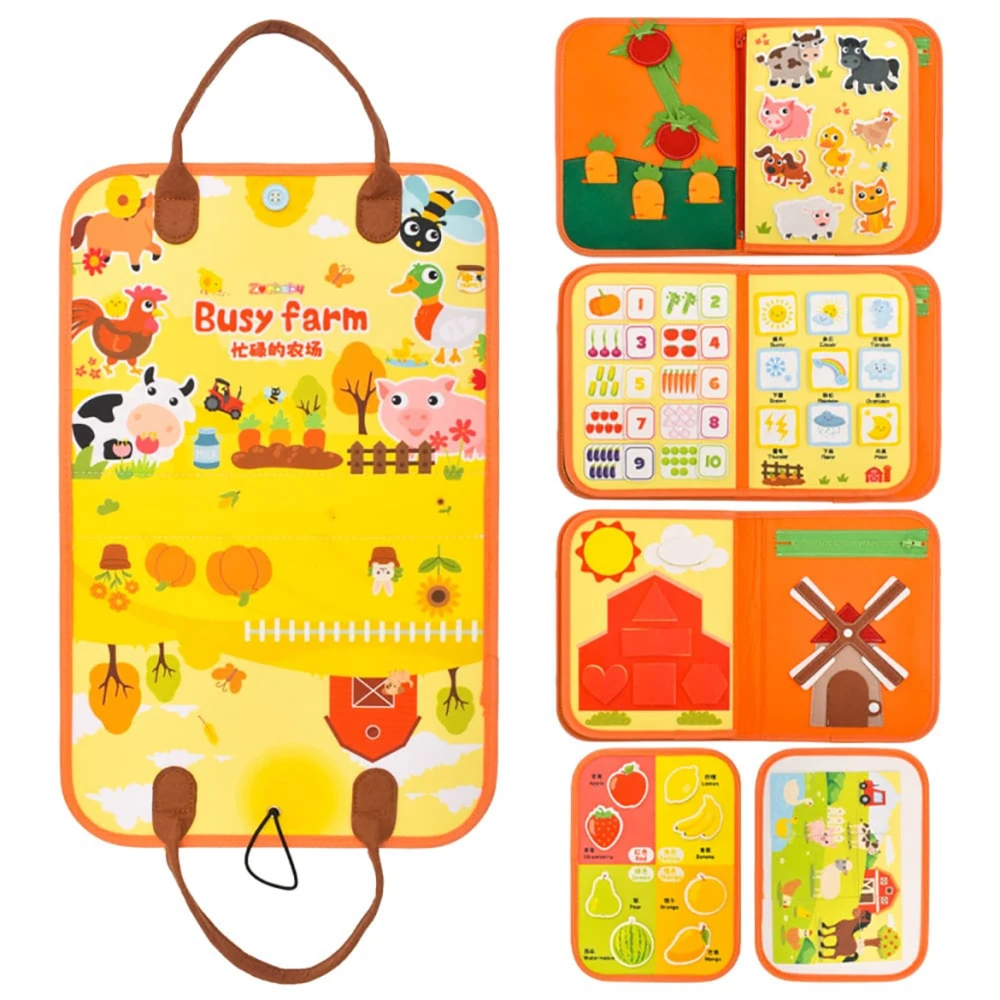
ZOE “Busy Farm” Busy Board combines an original modular design with a farm-themed learning concept. It is designed for fine motor skills training, hand-eye coordination, farm animal recognition, and sensory development.
Original Modular Farm-Themed Design
The product uses an exclusive original modular design centered on an immersive farm simulation concept.
Its activities include:
- Weather station
- Vegetable arithmetic
- Animal matching
- Pulling carrots
- Rotating windmill blades
The harvesting activities and rotating windmill blades provide tactile interaction, while the animal matching and vegetable activities support the overall farm-themed learning concept.
Twill Fabric, Eco-Polyester and Felt
The product uses twill fabric, eco-polyester, and felt.
Its twill fabric cover is designed to provide vibrant color reproduction and is described as stain-resistant and wipeable, supporting easier routine maintenance.
The printing technique is dye sublimation (heat transfer) printing.
Portable and Foldable Design
The product measures 28 × 21 × 5 cm and weighs approximately 0.45 kg per set.
Its portable and foldable design makes it suitable for travel activities during car and plane rides, home schooling, and preschool.
Product Specifications and Compliance
| Specification | Details |
| Product Name | “Busy Farm” Busy Board |
| Design | Exclusive Original Modular Design |
| Materials | Twill Fabric, Eco-Polyester, Felt |
| Printing Technique | Dye Sublimation (Heat Transfer) Printing |
| Size | 28 × 21 × 5 cm |
| Weight | Approx. 0.45 kg / set |
| Compliance | ASTM F963, CPSIA, EN71 |
| Compliance Age | 3 Years+ |
| Suitable Age | 18M+ |
| Custom MOQ | 2,000 sets |
| In-Stock MOQ | 500 sets |
| Custom Lead Time | 48 Days or Negotiable |
| Default Packaging | OPP Bag |
| Optional Packaging | Color Box |
Custom Busy Board Options for Brands and Distributors
For brands and distributors, customization can be important when developing a product line for a specific market.
The product supports OEM, ODM, and OBM services, providing options for companies that need a private-label or customized educational toy.
OEM, ODM and OBM Services
OEM, ODM, and OBM services can support different approaches to product development.
For this product, customization is available for brand identity and presentation rather than requiring buyers to use an entirely standard product.
Custom Logo, Colors and Packaging
The available customization options include:
- Logo placement
- Colorway adjustments
- Packaging modifications
The default packaging is an OPP bag, with a color box available as an option.
These options allow brands to adjust the product presentation according to their own identity and local market preferences.
MOQ, Lead Time and Commercial Terms
For customized orders, the MOQ is 2,000 sets. The MOQ for in-stock products is 500 sets.
The custom production lead time is 48 days or negotiable.
Available payment methods include T/T, PayPal, WeChat Pay, and Alipay. Available Incoterms include EXW, FOB, and DDP.
Conclusion: What Defines a High-Quality Felt Montessori Busy Board?
A high-quality Felt Montessori Busy Board should be evaluated as a complete product rather than simply by its appearance or the number of interactive components.
For B2B buyers, the main considerations are materials, interactive design, educational purpose, age suitability, safety compliance, customization, packaging, MOQ, and production requirements.
A well-designed Farm Busy Board can combine farm animal recognition, sensory interaction, fine motor skills training, and hand-eye coordination within a single themed product.
For brands and distributors, a Custom Busy Board also provides opportunities to adapt logos, colors, and packaging to suit different market requirements.
By evaluating these factors in a structured way, buyers can make more informed sourcing decisions and identify a busy board that matches their educational, branding, and commercial needs. Looking for a custom Felt Busy Board for your brand or educational product line? Contact us to discuss your OEM/ODM requirements, customization options, MOQ, packaging, and production schedule.