The market for early-learning products has shifted. Parents and educators no longer settle for a fabric book that only shows pictures; they expect the book to do something — a zip to fasten; a shape to match; a tool to grip. Meeting that expectation consistently, at a price the market accepts, is the hard part of the category. It is also what separates a product that stays on the shelf from one that sells through and reorders.
The questions below cover what actually matters when sourcing felt busy books: how OEM and ODM differ in practice, what belongs in a written specification, and which documents and commercial terms should be locked down before the first sample is even discussed.
Where Early-Learning Sourcing Goes Wrong
The failures in this category rarely come from the material. Fabric and felt are inexpensive. The cost and the risk sit in the design and the safety work, which is also where buyers most often make assumptions.
Safety expectations are high because the end user cannot judge risk. A loose button or a weak seam is not an inconvenience; it is a liability. Construction quality is hard to assess from a photograph, because stitching, part attachment, and print durability only reveal themselves after weeks of handling by a two-year-old. And the category moves quickly — a product that cannot be modified for the next season is a product that ages fast.
OEM, ODM and OBM: Three Different Relationships
The three terms describe who owns the design, not how large the order is.
With OEM, the buyer brings the drawings and the specification, and the factory manufactures to that brief. The buyer keeps full control and full differentiation, but also carries the development time and cost.
With ODM, the factory offers a design it has already built, and the buyer applies branding, packaging, and usually a limited set of changes. It is faster and cheaper to launch, but the same base may be offered to other buyers unless exclusivity is put in writing.
OBM is different again — it means the factory sells under its own brand, which makes it a competitor rather than a supplier.
Most programs start with ODM to test a market and then shift to OEM once volumes justify a proprietary design. If you are planning an ODM modification, your brief should state clearly which elements can change — colors, cover art, the number of activities — and which are fixed by the existing tooling.
What a Custom Felt Busy Book Specification Should Contain
Before requesting a sample, buyers should define the key product requirements to help the manufacturer understand their expectations and reduce unnecessary revisions. For a custom felt busy book, the specification should cover the following details.
Age band. State the compliance age and the marketed age separately, and describe supervision for each.
Activity inventory. The number of activities, the motor skill each one trains, and the order of difficulty.
Materials. Felt grade is the largest cost variable. Industrial-grade felt, eco-polyester, and genuine merino wool felt sit at different price points and behave differently; specify which is used, and where.
Printing. Dye sublimation, or heat transfer printing, drives color into the fibre rather than sitting on the surface, which affects both look and wear.
Dimensions and weight. These decide whether the product is genuinely portable — a point that matters for travel and church-bag use.
Part security and cleaning. How each removable piece is attached and what standard it must pass; whether the item is wipe-clean only.
The Compliance Documents That Matter
The standard references are ASTM F963 and CPSIA for the United States, EN71 for Europe, and California Prop 65 and RoHS for material restrictions. The key point is scope: a report for one SKU does not automatically cover the same item in a different colorway or with an added component.
Terms Worth Settling Before Design Work Begins
Minimum order quantities for custom and in-stock orders normally differ. Development time and production time are separate, and both should be requested. Packaging — standard bags, retail color boxes, or branded packaging — affects both cost and schedule. Incoterms and payment methods should be agreed at the quotation stage, and for OEM work, design and tooling ownership should be confirmed in writing.
The Noah’s Ark Felt Busy Book
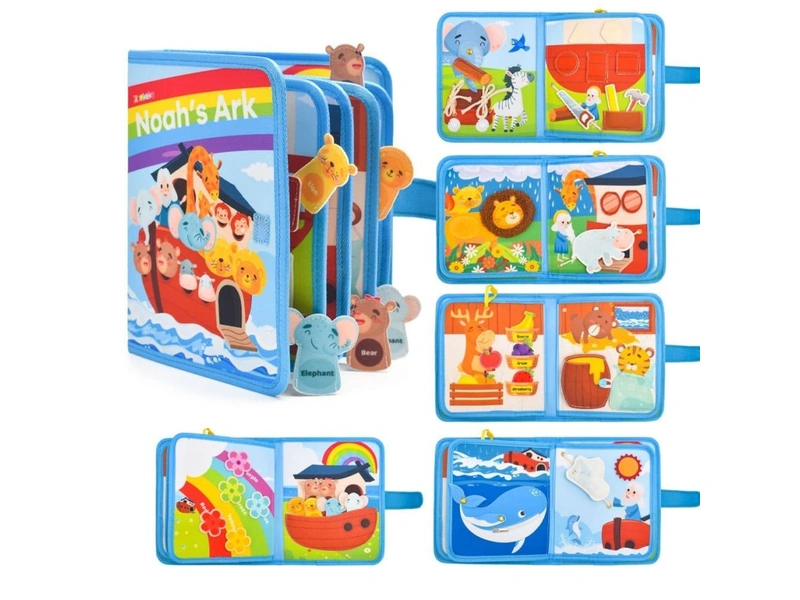
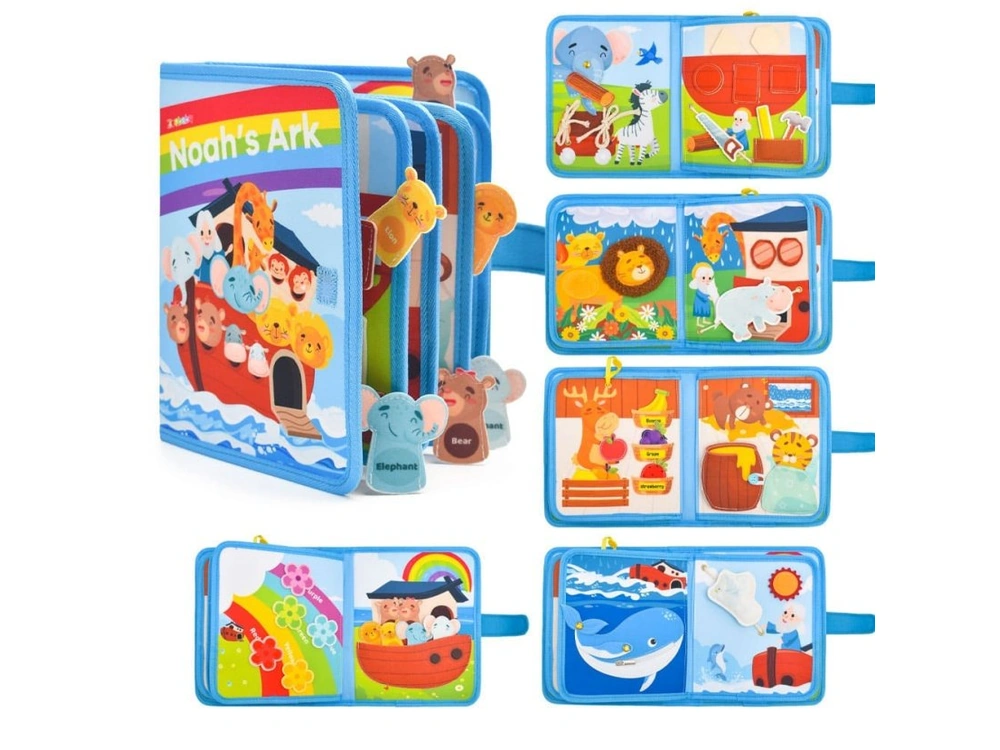
The Noah’s Ark Felt Busy Book shows how an existing original design can serve as the base for branding, customization, or a full OEM programme.
The book is built on an exclusive modular design, so the activities can be assembled and reconfigured rather than fixed as a page sequence. Twill fabric, eco-polyester, and felt are combined, with dye sublimation printing for the graphics.
The play centres on doing. Children use felt tools — a hammer and a saw — to construct the ark, then match rainbow colors and feed the animals. A tactile lion mane and a zippable whale mouth add sensory interest. The size and weight keep it practical for car journeys and flights.
Technical Specifications
| Item | Detail |
| Product Name | Noah’s Ark Book |
| Design | Exclusive original modular design |
| Customization | OEM / ODM / OBM |
| Materials | Twill fabric, eco-polyester, felt |
| Printing | Dye sublimation (heat transfer) |
| Size | 23.5 × 18.5 × 5 cm |
| Weight | Approx. 0.50 kg per set |
| Place of Origin | China |
| Certificates | ASTM F963, CPSIA, EN71 |
| Age Range | 3 years+ (compliance); suitable from 18 months |
| MOQ (custom) | 1,000 sets |
| MOQ (in stock) | 500 sets |
| Lead Time (custom) | 48 days, negotiable |
| Packaging | OPP bag (default); color box optional |
| Payment | T/T, PayPal, WeChat Pay, Alipay |
| Incoterms | EXW, FOB, DDP |
ZOE Felt Customization: How the Service Works
Knowing how the terms work is only useful if you can act on them. ZOE turns a specification into a delivered product through a structured customization service that covers the whole journey from first enquiry to shipment. The steps below show how a felt busy book project moves through the factory.
Step 1 — Confirm Requirements and the Right Model
A project starts with the buyer’s requirements: target age, theme, activity list, materials, dimensions, and target market. ZOE helps confirm which relationship fits — OEM for a proprietary design, ODM for an existing design with branding and adjustments, or OBM for a factory brand. Agreeing this up front sets the scope for everything that follows.
Step 2 — Specification and Sampling
ZOE’s in-house R&D team works specifically on early childhood products, which is what allows Montessori concepts to reach production at volume. The sample lets the buyer confirm construction, print quality, and part attachment before the order is committed.
Step 3 — Quotation and Commercial Terms
With the sample approved, ZOE issues a quotation that turns the specification into firm numbers. This is where the buyer and factory agree the minimum order quantity for custom and in-stock orders, the separate development and production lead times, the packaging option, the payment method, and the Incoterms. For OEM work, ownership of the design and tooling is confirmed in writing at this stage. Settling these points before production begins avoids the surprises that cost the most later.
Step 4 — Production and Quality Control
ZOE brings more than 15 years of felt manufacturing experience to the production stage, operating a 24,000-square-meter facility with five production lines and more than 100 advanced machines. Over 150 professionals work across production, quality control, and product development. Raw materials meet California Prop 65 and RoHS requirements, and products including busy boards and felt busy books are tested to EN71 and CPSIA, supporting CPC and CE certification. The company also holds ISO9001, BSCI and OEKO-TEX certifications, with products tested to meet Prop 65(California Proposition 65, CP65) and RoHS standards.
Step 5 — Packaging and Delivery
The final step is packaging and shipment. Standard OPP bags are the default, with retail color boxes or branded packaging available as options. Goods ship under the agreed Incoterms — EXW, FOB, or DDP — so the buyer knows exactly where responsibility transfers at every point.
Frequently Asked Questions
What is the difference between OEM and ODM for a felt busy book?
With OEM, the buyer supplies the design and the factory manufactures to it. With ODM, the factory supplies an existing design the buyer brands and adjusts. OEM offers more differentiation and takes longer; ODM is faster and cheaper but may not be exclusive unless agreed.
What is the minimum order for a custom busy book?
Custom orders start at 1,000 sets and in-stock orders at 500 sets. Custom lead time is approximately 48 days and can be negotiated.
What age is the Noah’s Ark Felt Busy Book suitable for?
It is certified for children aged three and above and suitable from 18 months, which means younger children should use it under supervision.
Conclusion
Choosing between OEM and ODM is a decision about differentiation, speed, and volume. What follows that decision is less visible but more important: a specification that says what the product must do, documents that cover the exact item being shipped, and commercial terms agreed before tooling starts.
If you are developing a custom felt busy book for your market, contact us to discuss specifications, samples, and lead times for your order.