More parents and educators are choosing Montessori-aligned felt story boards. These tools turn abstract concepts — animal names, habitats, numbers — into objects children can touch, move, and rearrange. This hands-on, screen-free activity fits naturally into home-based Montessori learning. In this guide, learn how a large zoo-themed felt storyboard helps toddlers develop fine motor skills, hand-eye coordination, language, and creativity through independent play.
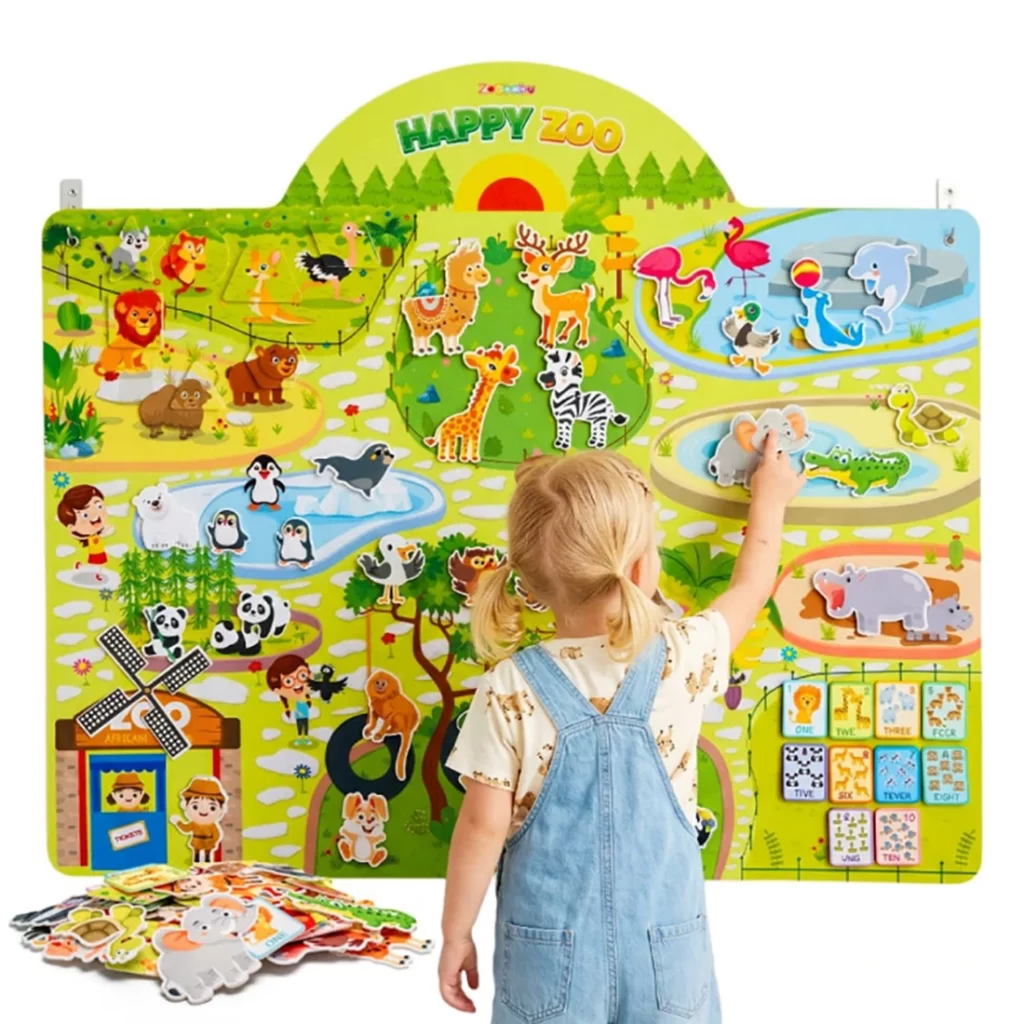
1.What Are Felt Story Boards
A felt story board features a soft, fabric surface to which felt pieces can firmly adhere without the need for glue, Velcro, or magnets. Children can place, peel, and reposition characters, animals, numbers, and scenery elements as they tell stories or complete learning tasks.
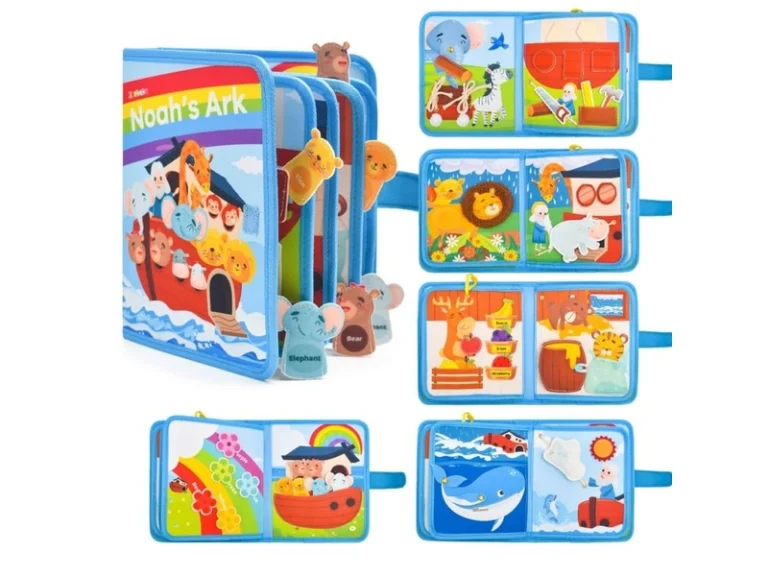
Modern felt story boards have evolved far beyond simple flannel boards(A flannel board (or felt board) is a versatile educational tool used primarily for storytelling, visual learning, and early literacy). Today’s designs include extra-large wall-mounted boards, themed playscapes (such as zoos, farms, or oceans), and complete educational kits containing dozens of felt pieces. They are widely used in Montessori homeschooling, preschools, and early intervention programs.
2.Why Montessori Learning Emphasizes Hands-On Educational Activities
The Montessori method is based on a simple idea: young children achieve the best learning outcomes through concrete, sensory experiences. When children are able to touch, move, and organize physical objects, abstract concepts—such as numbers, animal names, and habitats—come alive and real.
2.1 Learning Through Exploration and Play
In Montessori education, play is the child’s “work.” Felt storyboards give children the freedom to explore open-endedly. Today they might sort animals by habitat. Tomorrow they might tell a whole new story. That freedom allows each child to learn at their own pace.
2.2 Encouraging Independence and Self-Directed Learning
These felt pieces are lightweight, making them easy for small hands to grasp. If a piece is placed incorrectly, children can simply peel it off and reposition it. This ensures that children don’t get frustrated and that the activity remains tidy. Children can independently match numbers 1–10, build a pond for penguins, or create a savanna for giraffes. This builds confidence and concentration — two core goals of Montessori learning at home.
3.How Felt Story Boards Support Early Learning
3.1 Developing Fine Motor Skills
Peeling, grasping, placing, and repositioning felt pieces strengthens the small muscles in a child’s hands and fingers. These are the same muscles used later for writing, cutting, and buttoning clothes.
3.2 Improving Hand-Eye Coordination
Placing felt pieces in the right spot helps kids learn hand-eye coordination. Practice makes them more precise and more aware of space.
3.3 Supporting Cognitive Development and Problem-Solving
Felt boards naturally encourage sorting, classifying, matching, and sequencing. For example:
- Matching number cards 1–10 to corresponding animal counts
- Grouping animals by habitat (savanna, rainforest, arctic, aquarium)
- Sequencing story events (first the zookeeper feeds the animals, then they go to the pond)
These activities build logical thinking and early math skills.
3.4 Building Language and Vocabulary Skills
As children narrate stories or describe what they are doing, they naturally acquire new vocabulary:
- Animal names (giraffe, penguin, tiger)
- Habitat words (pond, iceberg, jungle)
- Action words (climb, swim, fly)
- Positional words (above, below, next to)
Parents and teachers can expand language by asking open-ended questions: “Why does the polar bear live near the ice?”
3.5 Encouraging Creativity and Storytelling
Unlike rigid worksheets, felt boards invite imagination. A child can make the zookeeper rescue a tiger, or have a monkey visit the arctic “just for fun.” This narrative play supports emotional expression, planning, and narrative sequencing.
4.Why This Zoo-Themed Felt Story Board Stands Out for Early Learning
4.1 An Extra-Large Interactive Playscape for Group or Solo Play
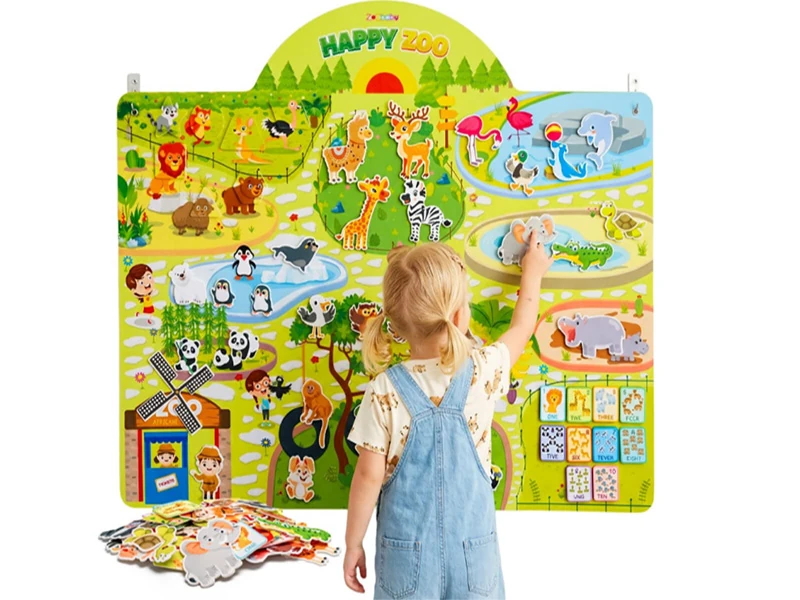
The felt wall board measures 1210mm × 1050mm (approximately 47 × 41 inches). It is large enough to cover a significant portion of a wall. Multiple children can play side by side, which naturally fosters cooperation, negotiation, and the creation of stories together. For individual children, this vast “canvas” provides them with ample space to express themselves and create undisturbed.
4.2 90+ Pieces Covering Animals, Numbers, and Habitats
This set contains over 90 high-quality felt pieces, including:
- Zoo animals (giraffe, lion, elephant, monkey, penguin, polar bear, fish, etc.)
- Zookeeper characters
- Number cards 1–10 for matching and counting
- Habitat elements (trees, water, ice, rocks)
4.3 Multiple Themed Zones That Encourage Open-Ended Storytelling
- Savanna
- Rainforest
- Arctic pond
- Aquarium
Children can place a penguin in the Arctic zone and a crocodile in the aquarium, and then devise a story that connects the two. This structure avoids overwhelming them while simultaneously stimulating a rich imagination.
5.Benefits of Felt Story Boards for Home Learning
Beyond specific educational outcomes, felt story boards offer practical benefits that matter to busy parents and teachers.
5.1 Providing Screen-Free Educational Entertainment
In an age of tablets and smartphones, felt busy boards offer a compelling, quiet, low-tech alternative. Children remain engaged for 20–40 minutes at a time — long enough to give parents a break or teachers a focused learning block.
5.2 Supporting Independent and Parent-Guided Learning
The board can be used in two modes:
- Independent play: The child freely arranges pieces and creates stories.
- Parent-guided learning: An adult introduces specific concepts (counting, vocabulary, habitat sorting).
Both modes respect the Montessori balance between freedom and structure.
5.3 Portable, Wall-Mountable, and Easy to Store
Despite its large size, the board is:
- Foldable and lightweight (approx. 1 kg)
- Easy to hang on any flat surface
- Storable in a closet or behind a door
This makes it ideal for homeschoolers who need to rotate materials, or for classrooms with limited wall space.
6.How to Choose a Safe and Educational Felt Story Board
Not every felt board on the market meets safety and durability standards. Here is what to look for.
6.1 Look for Child-Safe Materials and Certifications
The aforementioned zoo-themed felt boards are made of environmentally friendly polyester felt and printed using dye sublimation (thermal transfer) technology—the entire process is free of glue and heavy metals. Our products comply with:
- ASTM F963 (US toy safety standard)
- CPSIA (Consumer Product Safety Improvement Act)
- EN71 (European toy safety standard)
Our products meet California Prop 65 and RoHS environmental standards. These certifications are essential for selling in the US and EU markets, and they give parents peace of mind.
6.2 Consider Age-Appropriate Learning Content
While the board is formally certified for ages 3+, it’s also designed to be suitable for children 18 months and older with supervision. The pieces are large enough to avoid choking hazards, and the themes — animals, numbers, zookeepers — match toddler cognitive development well.
6.3 Evaluate Durability and Reusability
High-quality felt boards hold pieces securely even after hundreds of repositionings. The felt does not pill, stretch, or lose its grip. This product is designed for endless reuse — no adhesives, no fading, no tearing.
7.Conclusion
For those seeking a Montessori-aligned, space-efficient activity that truly engages toddlers, this large zoo-themed felt board for wall is an excellent choice. It features over 90 felt pieces, multiple habitat zones, a wall-mountable design, and ASTM/CPSIA/EN71 safety compliance. The result is screen-free play that develops fine motor skills, cognitive abilities, language, and creativity. If you are interested in our products, please contact us for a quote.